High-Security Network Solutions for Banks and Government Institutions

Banks and government institutions require the highest levels of security, reliability, and operational continuity.

High-Security Network Solutions are designed to protect sensitive financial data, confidential public records, and mission-critical systems against cyber threats, unauthorized access, and service disruptions.

Through advanced fiber-optic networks, encrypted PON architecture, and multi-layer security mechanisms, organizations can ensure uncompromised protection and ultra-stable connectivity across all departments and branches.


These solutions support encrypted communication, isolated network segments, real-time threat monitoring, high-availability redundancy, and centralized management ensuring that critical services remain operational 24/7.

With secure PON topologies and strong authentication mechanisms, institutions can maintain compliance with stringent global standards while enabling efficient digital operations and rapid service delivery.


Project Requirements

1

Secure Transaction & Citizen Services Floor

To support highly sensitive financial and governmental operations, it is necessary to have exclusive, encrypted high-speed access to classified resources and strictly separate them from public access. Banking staff and government agents require secure VDI (Virtual Desktop Infrastructure), biometric ID scanning, and crypto-voice communications, with zero-trust network access and guaranteed bandwidth to ensure no data leakage.

2

National Security & Compliance Command Center

Meet the rigorous demands of real-time global threat monitoring and compliance tracking. The network must ensure continuous, highly reliable, and ultra-low latency access for security analysts, supporting encrypted high-capacity displays and continuous fraud detection dashboards while strictly blocking unauthorized internal or external network access.

3

Classified Meeting Rooms and Public Kiosks

To facilitate secure cross-departmental collaboration, classified meeting rooms require hardened endpoints, scrambler systems, and encrypted multimedia conferencing. Simultaneously, public access areas must provide isolated, secure citizen service kiosks and guest Wi-Fi that are physically and logically segregated from the core institutional network to completely eliminate the risk of cross-contamination or data breaches.

4

Perimeter and Critical Infrastructure Security Zone

To cope with strict physical security mandates, the outdoor network must work stably with anti-tamper mechanisms and one-fiber multi-service capabilities. It must carry edge-encrypted HD CCTV surveillance, biometric entry control data (facial/iris recognition), Automatic Number Plate Recognition (ANPR) systems, and seismic sensors, executing immediate lockdown protocols and visual event linkage before any perimeter breach occurs.

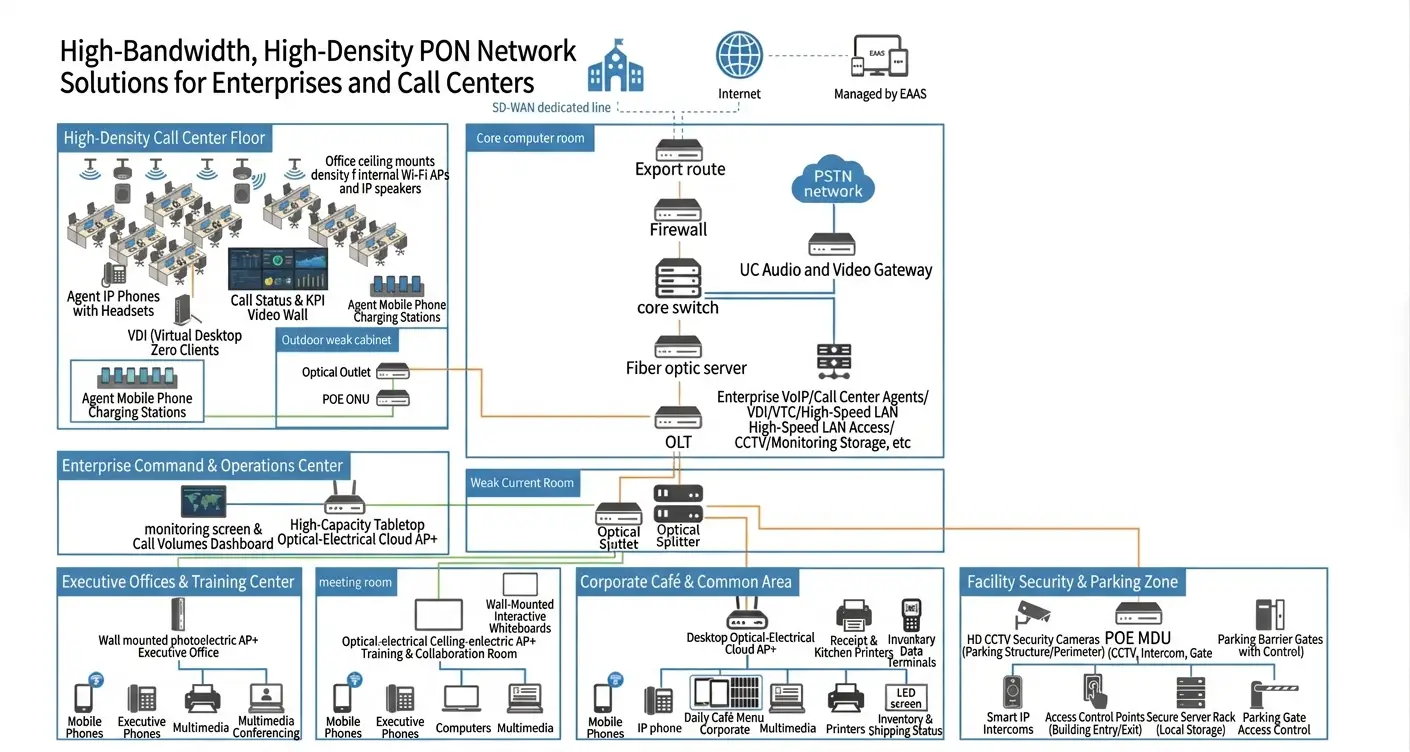
Network Topology

Network Topology

Highlights of the Solution

Bank-Grade Data Encryption and Zero Trust

End-to-end encryption for all sensitive financial and classified government data. The network enforces a Zero Trust architecture, strictly isolating secure transaction processing from public or guest networks to prevent any unauthorized access.

Simplified Architecture with Minimized Vulnerabilities

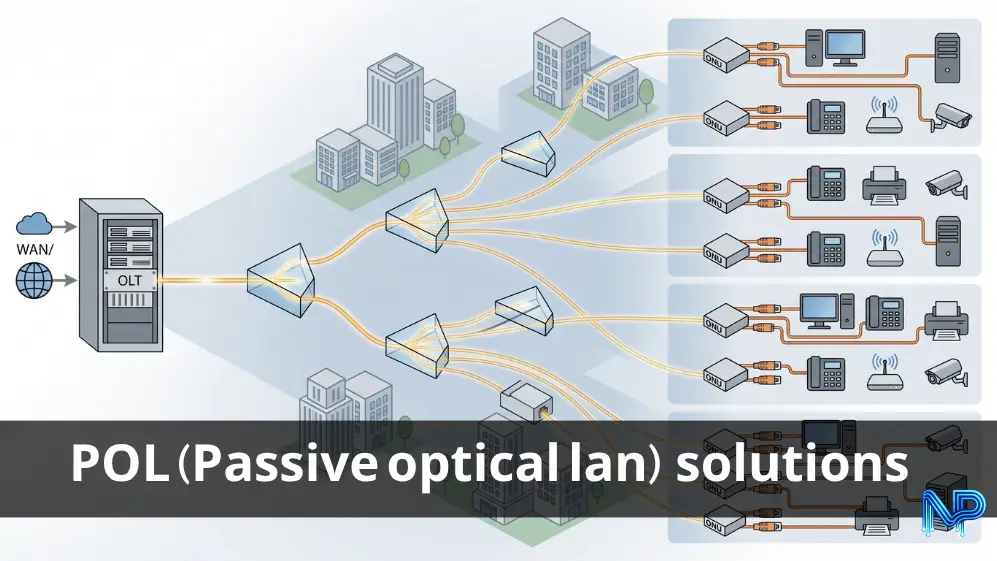
The two-layer passive optical network significantly reduces the number of active routing devices required in hallways and weak-current rooms, drastically minimizing physical vulnerability points and potential hardware breaches.

Multi-Layer Threat Prevention & High Availability

Equipped with hardened firewalls and redundant core systems. It supports fast 50ms link switching to ensure continuous, uninterrupted uptime for mission-critical command centers and real-time global market transactions.

Physical Security and Anti-Tap Transmission

Pure dielectric optical fibers are completely immune to electromagnetic interference (EMI) and highly resistant to physical wiretapping attempts, guaranteeing secure long-distance data transmission across government campuses and bank branches.

User Value

Strict Regulatory Compliance

Meets the most rigorous national security, banking, and financial auditing standards by guaranteeing absolute data integrity, logical isolation, and detailed compliance monitoring.

Unified Infrastructure with Absolute Isolation

Safely carries both highly classified internal traffic (like secure VDI and crypto-phones) and public citizen services (like POS terminals and guest Wi-Fi) over the same physical infrastructure using strict logical segregation.

Proactive Threat Mitigation

Integrates edge-encrypted CCTV, biometric access control, and anti-tamper sensors, executing automated visual linkages and instant lockdown protocols to detect and neutralize threats before they reach critical assets.

Reduced Operational Risk and Costs

Eliminating the need for distributed active switches reduces manual maintenance, saves on cooling and space requirements in secure facilities, and lowers overall operational and energy costs by up to 30%.

Uncompromised Operational Efficiency

Intelligent bandwidth allocation ensures that high-capacity tasks, such as centralized fraud detection and secure file transfers, always receive priority routing without experiencing latency, even during peak public service hours.