Network Scenario for Factories and Industrial Facilities
Modern factories and industrial facilities are evolving into highly connected environments driven by automation, real-time monitoring, robotics, and centralized management systems.
To support this digital transformation, Passive Optical Network (PON) solutions offer an ideal foundation for building robust, scalable, and cost-efficient network infrastructures. PON technology eliminates the limitations of traditional copper-based networks by delivering high bandwidth, long-distance coverage, electromagnetic immunity, and reduced operational complexity all critical factors in harsh or large-scale industrial environments.

With PON, factories can efficiently connect production lines, IoT sensors, automated machines, surveillance systems, and administrative offices through a single, unified fiber infrastructure. This results in improved reliability, enhanced security, lower maintenance costs, and the ability to support future high-bandwidth applications such as Al-assisted operations and advanced robotics.
By adopting PON network solutions, industrial facilities can ensure long-term scalability, seamless integration with Industry 4.0 technologies, and a strong backbone capable of supporting continuous operational excellence across all departments.

Project Requirements
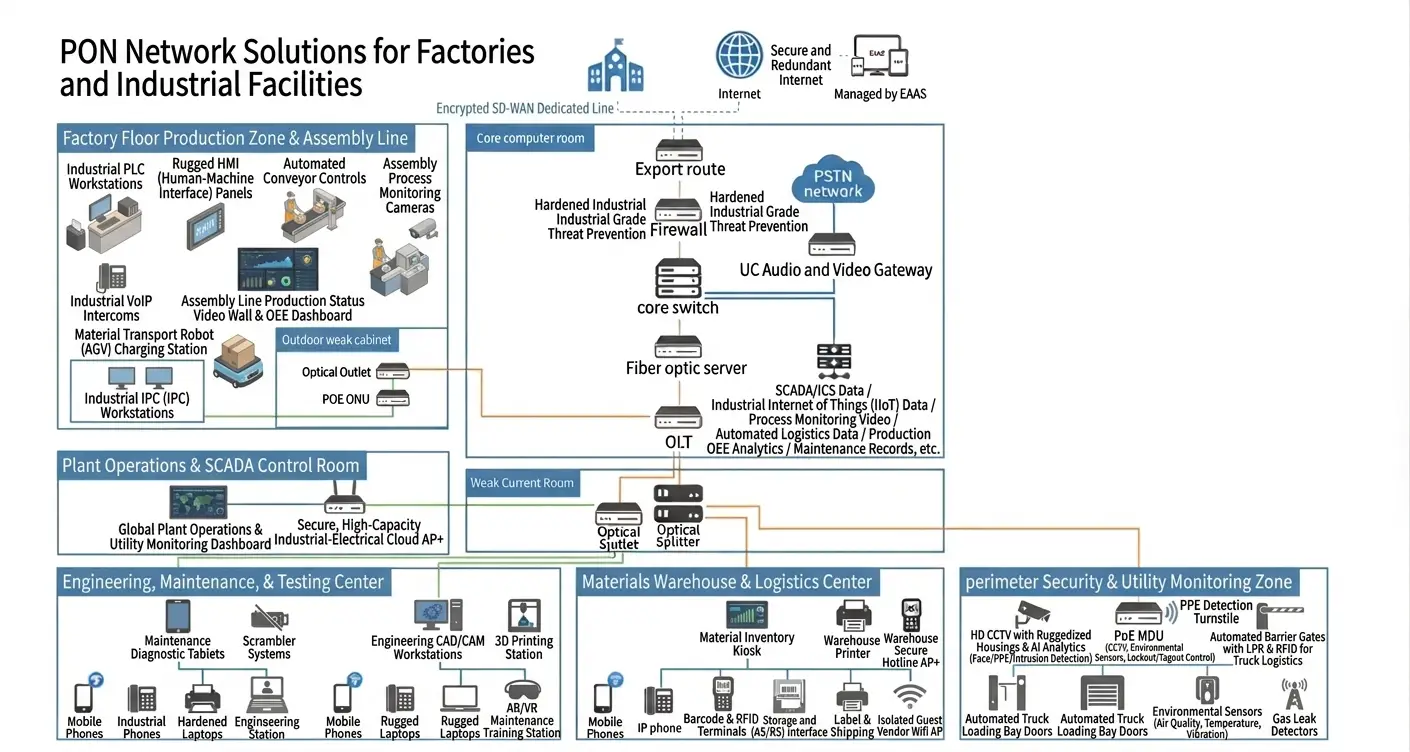
Factory Floor Production Zone & Assembly Line
To support heavy industrial automation and continuous manufacturing, it is necessary to provide ultra-reliable, low-latency, and high-density network access for operational technology (OT). The network must handle concurrent data from Industrial PLC Workstations, rugged HMI (Human-Machine Interface) panels, automated conveyor controls, and material transport robots (AGVs). Equipment deployed in this zone must be ruggedized to withstand dust, vibration, and extreme temperatures.
Plant Operations & SCADA Control Room
Meet the rigorous demands of centralized industrial control and Real-Time Overall Equipment Effectiveness (OEE) monitoring. The network must ensure zero-packet loss and continuous high-bandwidth transmission to carry real-time SCADA/ICS data, process monitoring video walls, and predictive maintenance diagnostics, completely isolated from corporate networks to ensure maximum cybersecurity.
Materials Warehouse & Logistics Center
Provide seamless and secure connectivity across extensive storage areas to support supply chain automation. The infrastructure must support material inventory kiosks, automated barcode & RFID storage/retrieval systems (AS/RS), and wireless handheld data terminals, while offering a strictly isolated guest Wi-Fi network for third-party shipping vendors and logistics partners.
Perimeter Security & Utility Monitoring Zone
To safeguard critical infrastructure and ensure worker safety, the outdoor and utility network must work stably with outdoor-grade PoE MDUs. It must carry high-definition CCTV cameras with ruggedized housings and Al analytics (for facial/intrusion and PPE compliance detection), automated truck logistics barrier gates, safety turnstiles, and critical environmental sensors (such as gas leak, vibration, and air quality detectors).
Network Topology
Highlights of the Solution
Industrial-Grade Ruggedization & Anti-Interference
The solution utilizes pure dielectric fiber optic cables that are completely immune to heavy electromagnetic interference (EMI), radio frequency interference (RFI), and power surges caused by heavy machinery or arc welding. ONUs feature wide-temperature specifications (-40°C to 70°C) and 6KV lightning protection.
Deterministic Low Latency for OT & SCADA Continuity
Enforces strict traffic prioritization and features ultra-fast 50ms link protection switching. This guarantees that critical industrial control commands, safety alarms, and SCADA data streams remain uninterrupted, eliminating costly production line downtime.
High-Density IIoT Carrying Capacity
Leveraging a 1:128 high spectral split ratio, a single PON infrastructure can connect thousands of Industrial Internet of Things (IIoT) sensors, smart valves, and production cameras over long distances (up to 20km) without needing active cascading switches on the plant floor.
Unified IT/OT Convergence with Absolute Isolation
Integrates critical industrial control systems (ICS), security surveillance, enterprise ERP access, and logistics networks into one simplified physical network while maintaining absolute logical/business logic isolation to satisfy strict industrial security standards.
User Value
Maximization of OEE (Overall Equipment Effectiveness)
Real-time data visualization and instant transmission of production status dashboards help plant managers identify bottlenecks instantly, optimizing production line speed and reducing unexpected downtime.
Drastic Reduction in TCO and Maintenance Costs
By replacing active hallway switches with passive optical splitters on the factory floor, the facility reduces manual maintenance risks, eliminates the need for air-conditioned weak-current rooms in harsh environments, and cuts operational costs by up to 80%.
Enhanced Workplace Safety and Compliance
Integrates automated PPE detection at turnstiles, ambient gas leak detectors, and localized video-shout broadcasting, enabling proactive incident prevention and enforcing strict Lockout/Tagout (LOTO) protocols.
Streamlined Logistics and Supply Chain Speed
Provides high-speed connectivity for automated warehouse systems (RFID/AS-RS) and automated loading bays, ensuring faster truck turnaround times, accurate inventory updates, and synchronized shipping workflows.
30-Year Future-Proof Scalability
The passive optical distribution network (ODN) remains completely unchanged during upgrades. Bandwidth can evolve from 2.5G to 10G or 50G by simply replacing the head-end OLT and tail-end ONUs, ensuring the facility is ready for next-generation smart manufacturing (Industry 4.0).